
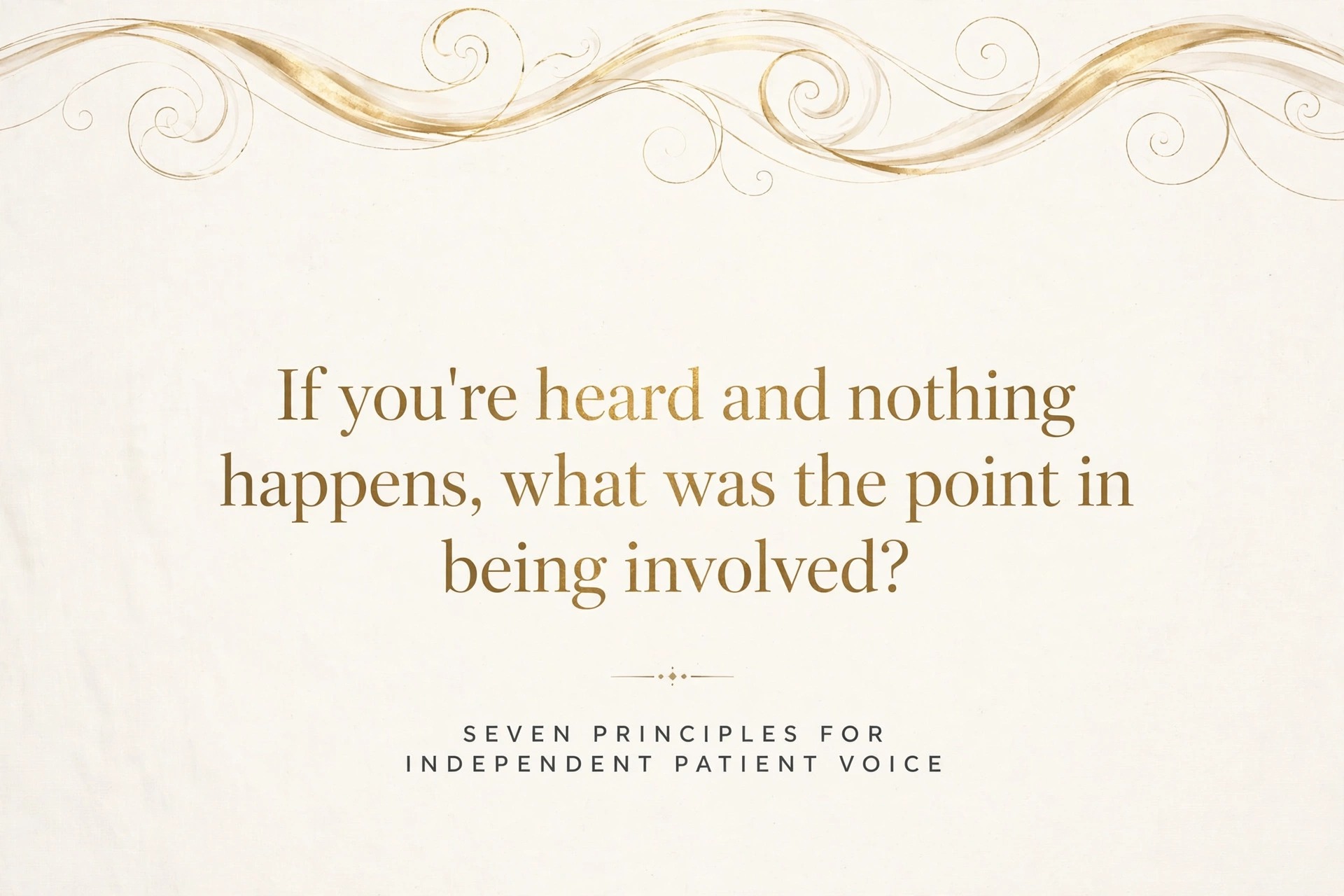
“If you’re heard and nothing happens, what was the point in being involved?”
That question — from a patient at a roundtable in London earlier this month — cuts through years of polite conversation about patient engagement. Being listened to is not the same as being heard. And being heard is not the same as changing anything.
On 8 October 2026, the Patients Association (UK)brought together patients, carers, and representatives from national and community organisations to answer a pressing question: as the Health Bill moves through Parliament, what does independent patient voice actually need to look like? Their report sets out seven principles — and they read like a practical test every decision-maker should have to pass.
The seven principles, in brief
- Independence and freedom to speak — patients must be able to share experiences openly, without interference from the organisations responsible for their care.
- Partnership and co-production — patients and carers involved as equal partners from the outset, not consulted after decisions are made.
- Impact and accountability — decision-makers must respond publicly, explain what action they will take, and show what changed.
- Equal voices and equal say — reaching people from all backgrounds, especially those least likely to be heard.
- Clear powers and responsibilities — legal powers to access information and visit services, with real routes to escalate concerns.
- Protected and fair funding — secure, long-term funding allocated according to need.
- Built with community organisations — recognising and funding the trusted charities patients already turn to, while keeping them free to challenge the system.
Why this matters beyond the Health Bill
You don’t need to follow Westminster to feel the relevance. Every health system, research project, and advisory board faces the same fault line: the gap between inviting patients in and sharing power with them.
At WKG Foundation, we’ve seen this up close. When we presented our framework for meaningful patient partner engagement — Accessibility, Reciprocity, Operational Integration — the response that landed hardest was the simplest one: patient partners aren’t a checkbox. Involvement that doesn’t change decisions isn’t engagement. It’s theatre.
The Patients Association’s report makes the same point at policy level. Without independence, legal powers, and protected funding, patient voice becomes decoration — something systems point to, rather than something that moves them.
What decision-makers should take from this
The report’s challenge is direct: protect the independence of patient voice bodies. Require public responses with clear timescales and evidence of action. Give patient voice genuine legal powers. Fund it fairly. And recognise the community organisations patients already trust.
Every patient, wherever they live and whoever they are, should have the opportunity to be heard — and to see that their voice led to change.
Read the full report from the Patients Association: Shaping independent voice in the Health Bill: seven principles for what comes next